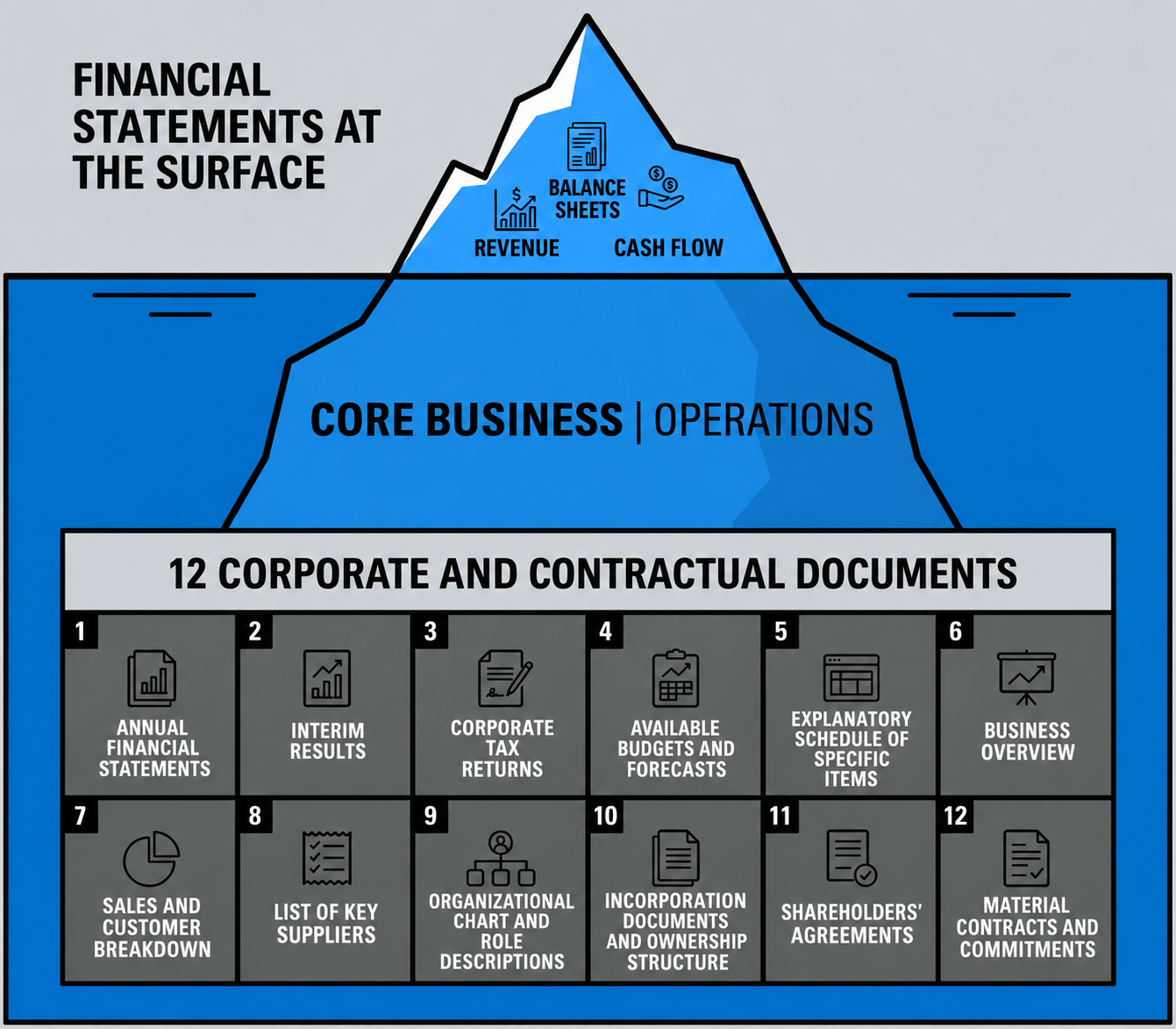
You may be considering a sale, planning for succession or looking to better understand the value of your business. The documents you gather help explain your financial performance, operations and commitments.
This preparation also helps demonstrate the maturity of your business’s management practices to a buyer, banker or shareholders. A coherent set of documents shows that you understand your revenue sources, obligations and risks. It facilitates discussions and helps identify questions to resolve before making a decision.
Start by organizing the information into three folders:
- Financial information: understand performance and assumptions.
- Operations: document how the business operates and what it depends on.
- Corporate documents: clarify ownership, rights and commitments.
This business valuation checklist provides a starting point with twelve items. Some include several documents. The list should be tailored with the business valuator to reflect the business, the valuation date and the scope of the engagement.
Before Gathering Documents: Clarify the Decision the Valuation Will Support
Preparing for a sale, arranging a share buyback and documenting a reorganization do not raise exactly the same questions.
First, identify the decision to be made, the shares or assets involved, the timeline and the people who will use the valuation. Also clarify the date as of which the value must be established.
This information helps focus the document collection process and determine the relevant periods.
Folder 1 — Financial Information
1. Annual Financial Statements
Gather the financial statements, accompanying notes and available supporting schedules for the fiscal years requested. Three to five years is a common starting point, to be confirmed based on the engagement.
These documents help the valuator examine trends in revenue, margins and financial position. Source: BDC.
2. Interim Financial Results and Supporting Schedules
Include the financial results available since the most recent fiscal year-end. Specify the period covered and any entries that have yet to be recorded.
As needed, include details of accounts receivable, inventory, capital assets and debt to help explain the balances.
3. Corporate Tax Returns
Prepare the company’s tax returns for the years requested, together with the relevant schedules and notices of assessment.
Your CPA can help you gather the correct versions and explain differences between the tax and accounting information.
4. Available Budgets and Forecasts
Gather any existing budgets, financial forecasts and cash flow projections. Include their main assumptions, such as sales growth, hiring, capital expenditures or changes in costs.
If you do not have formal forecasts, let the valuator know. Discuss whether they are needed before preparing them specifically for the engagement.
5. A Schedule Explaining Items Requiring Particular Attention
Identify events that warrant an explanation: an unusual expense, one-time income, a change in management compensation or a transaction with a related company.
Specify the nature, period and amount of each item, together with any available supporting documents. Identifying an item does not mean that an adjustment will automatically be accepted.
Folder 2 — Operations
Operational information helps explain the risks behind the numbers. Customer concentration and dependence on the owner or key individuals can affect the transferability of the business and its value. Source: BDC.
6. An Overview of the Business
Prepare a description of your products and services, the markets you serve and how the business operates.
An existing document may be sufficient if it is current. The goal is to explain how the business generates revenue and which resources support its operations.
7. A Breakdown of Sales and Customers
Gather sales information by customer, product, service or business segment, based on the available data and the valuator’s request.
Highlight customer concentration risks. A customer accounting for more than 20% of revenue, for example, warrants closer analysis. This percentage is illustrative: it is neither a universal threshold nor a basis for an automatic discount.
Specify the length of the relationship, the contracts in place and the potential consequences of losing customers. Also indicate whether the relationship depends primarily on the owner and how it could be transferred.
8. A List of Key Suppliers
Identify essential suppliers, the proportion of purchases they represent and the available alternatives.
Document critical dependencies: a sole supplier, the time needed to find a replacement, exclusive terms or supply arrangements that depend on the owner’s personal relationships.
This information helps assess business continuity. Depending on the circumstances, significant dependence may weigh on value, while documented alternatives may mitigate the risk. No adjustment follows automatically from a supplier’s share of purchases.
9. An Organizational Chart and Description of Responsibilities
Present the key functions, team responsibilities and the owner’s role.
Who manages business relationships? Who holds the technical knowledge? Who authorizes major decisions?
Specify which responsibilities have been delegated, which processes are documented and what options exist for replacing key individuals. This helps the valuator understand the business’s ability to operate following a change in ownership.
Folder 3 — Corporate and Contractual Documents
10. Incorporation Documents and Ownership Structure
Gather the articles of incorporation, any amendments and current share ownership information. If several companies are involved, include a diagram showing their relationships and the assets they hold.
Have the company’s tax advisor and lawyer validate the structure and the rights attached to the shares, in coordination with the valuator. This review helps clarify what is being valued and identify relevant rights or restrictions.
11. Shareholders’ Agreements
Prepare the agreements currently in effect and any amendments, particularly provisions concerning transfers, share buybacks, voting rights and exit mechanisms.
Their review should draw on the expertise of the valuator, tax advisor and lawyer. Control rights and the ability to transfer shares may influence the analysis of minority discounts or discounts for lack of marketability. These are reductions associated with a lack of control or difficulty reselling an ownership interest.
These discounts do not apply automatically. Their relevance depends on the actual rights, contractual provisions, legal framework and valuation context. Source: MNP.
12. Significant Contracts and Commitments
Gather the contracts relevant as of the valuation date: leases, financing agreements, commercial agreements, franchise agreements, licences and intellectual property documents.
Flag change-of-control clauses, guarantees, specific commitments and disputes that may be relevant to the engagement. The valuator will identify the documents needed, with support from the appropriate advisors.
How Should You Organize the Collection Process?
Assign responsibility for each of the three folders:
- The owner explains the operations, key relationships and outlook.
- The CPA or controller coordinates the financial information and supporting explanations.
- The tax advisor and lawyer validate the aspects of the structure and agreements that fall within their expertise.
For each file, identify the company, period and version. Flag missing or preliminary information, and keep assumptions with the figures they relate to.
Before sharing confidential information, agree with the valuator on how it will be shared and who will need access.
Do You Need to Wait Until Everything Is Ready?
You can start the discussion with an incomplete set of documents. Indicate what is available, what is missing and what requires clarification.
Preparation makes the business easier to understand and helps identify risks to examine. It may also reveal opportunities to improve management practices before a transaction, without guaranteeing a higher value.
Use this checklist with your advisors to organize the three folders and track the documents to gather. The list can then be adjusted with the valuator to reflect your situation.
Use this business valuation checklist with your advisers
For help explaining unusual financial items, read our guide to normalized EBITDA and earnings adjustments. To clarify the purpose of the engagement, see when to get a business valuation in Canada.
Are you advising a business owner in Ontario or Quebec? SME Business Appraisers can help clarify the scope of the valuation and the documents to gather with the owner, CPA, tax adviser and lawyer. Discuss your situation.